

Donor acquisition guide: 8 strategies to find new nonprofit donors

Acquiring new donors is an investment. It can cost nonprofits $1.50 to raise $1.00 from a new supporter. Additionally, economic uncertainty, changes in donor behaviors, and a shift in trust from institutions to individuals emphasize how critical it is for nonprofits to adapt their strategies to align with today’s best practices.
For modern nonprofits, getting supporters to donate must involve a multichannel approach and efforts to meet them where they are. To help identify prospective donors and cultivate your next wave of lifelong supporters, we’ve rounded up eight techniques to expand your donor base and foster loyal relationships.
Explore effective ways to source donations across various giving levels and learn how GoFundMe and GoFundMe Pro’s innovative tools can help make outreach easier.
Build your donor acquisition channel mix
The strongest donor acquisition strategies use multiple channels working together. Use the framework below to prioritize your efforts, coordinate your outreach, and build a strong foundation for growth.
Start with your warmest acquisition channels
Not all donor acquisition channels offer the same value. Start by building momentum with people who already know your organization or have a connection to your cause. That includes your email subscribers, social media followers, supporters who can activate their communities through peer-to-peer fundraising, and people who discover your GoFundMe Nonprofit Page.
These warmer audiences are more likely to engage at a lower cost than people hearing about your mission for the first time. Strengthen these channels first, then expand your reach through paid advertising, direct mail, corporate prospecting, and other acquisition strategies.
Layer outreach across multiple touchpoints
Prospective donors rarely give after hearing about your organization once.
Instead, build familiarity and trust by reaching them across multiple channels. Someone might discover your mission on social media, receive a fundraising letter, or see a friend supporting your cause through a peer-to-peer fundraiser. Each interaction creates another opportunity to connect and move them closer to giving.
Plan your outreach so these channels work together to reinforce your message and help potential donors get to know your organization over time.
Track cost per acquired donor by channel
Once you’ve run a multichannel donor acquisition campaign, look at which channels delivered the strongest results. Calculate your cost per acquired donor by adding up each channel’s expenses, including staff time, platform costs, and materials, and dividing that total by the number of new donors it generated.
Then, compare that cost with donors’ projected lifetime value and retention rates. Channels that bring in donors at a lower cost and keep them engaged over time may be worth more investment in your next campaign, helping you focus resources where they can have the greatest impact.
Now that you’ve built your donor acquisition channel mix, let’s explore eight top strategies to attract new donors to advance your mission.
1. Conduct prospect research
Prospect research involves gathering and analyzing detailed information about potential donors to understand who they are, what drives them, and how they might connect to your cause. Information you may collect in your donor database includes:
- Philanthropic history: Investigate past giving behaviors for insights into future generosity, such as monetary and in-kind donations to other nonprofits, participation in volunteer opportunities, political giving, and support of similar causes.
- Wealth screening: Identify financial capacity with wealth markers, such as net worth, real estate holdings, stock holdings, and business affiliations.
- Charitable motivations: Delve into the “why” behind a prospective donor’s giving. Which causes do they care about? What inspires their generosity?
- Personal backgrounds: Get to know individual donors to tailor your approach by gathering information on demographics, hobbies, marital status, communication preferences, and professional and educational backgrounds.
Nonprofits can tap different databases, historical records, and other research methods to collect specific information, storing it in their customer relationship management (CRM) platform to create complete donor profiles. This approach to donor management can help:
- Drive hyperpersonalized content.
- Inform major donor outreach.
- Identify planned or deferred donors.
- Discover new donor cohorts.
Prospect research is the first step toward expanding your nonprofit’s reach and impact. GoFundMe Pro’s fundraising platform can then help turn your research into action with options like flexible donation pages and donation forms tailored to your unique brand, goals, and donor preferences. Plus, gain access to in-depth fundraising intelligence and analytics to keep your finger on the pulse of your fundraising efforts and make refinements as needed.
2. Leverage peer-to-peer fundraising
The 2026 Edelman Trust Barometer found that, among people whose trust has been shaped by recent events, trust in neighbors, family, and friends saw a net gain of 11 points. By comparison, major news organizations saw a net decline of 11 points, whereas national government leaders declined 16 points. These findings point to the growing importance of personal connections in building trust.
GoFundMe’s Gen Z Generosity report supports this. Nearly 60% of Gen Z say their giving decisions are influenced by family or peers, and most Gen Zers and Millennials follow impact creators online, with 1 in 4 Gen Zers saying they donated as a result of a social media creator.
Given that people trust other people more than organizations, leveraging current donors’ interpersonal relationships to cultivate interest and support for your nonprofit is an excellent avenue for donor acquisition. One of the most effective ways to do this is through peer-to-peer fundraising, which allows supporters to advocate for your cause and expand your reach in a cost-effective way.
Encourage long-time supporters to assist you with this type of gift fundraising, letting them know how much of an impact it can have on your organization.
Once individuals give a one-time donation through a friend’s peer-to-peer fundraising efforts, use their contact information to send a welcome series. Offer quick ways they can continue to engage with your cause and tell compelling stories that drive them to take further action.
Social media continues to be a powerful tool for finding nonprofit donations. GoFundMe’s Gen Z Generosity report found that more than 70% of Gen Z report some form of giving compared to 65% of adults aged 30–85.
Nonprofits can leverage this enthusiasm to expand their message’s reach and acquire new donors.
First, gauge your staff’s capacity to expand your social media presence and identify which social media platforms best align with your goals and supporters’ preferences. For example, you can:
- Capitalize on the traffic potential of Facebook to boost cause awareness.
- Share efforts on LinkedIn for higher conversion opportunities.
- Unlock traffic with a multiplatform approach spanning popular channels like TikTok and Instagram.
To encourage online donations, follow social media best practices, such as:
- Create social media business profiles.
- Schedule posts around the times and days your audience is most active.
- Stay ahead of new trends and algorithm shifts.
- Prioritize brand and posting consistency across platforms.
- Emphasize short video content and powerful imagery.
- Incorporate digital advertising into your strategy when budget allows.
Additionally, leverage GoFundMe Pro’s social sharing integration with Meta, which makes it easier for donors to find, share, and support causes on their preferred social channels. You can use the integration to:
- Inspire donor action through Instagram Stories and in-feed Facebook posts that have a donation button and dynamic progress metrics.
- Stand out in the feed with a fresh, polished look.
- Gain access to rich donor data and insights with funds processed exclusively through GoFundMe Pro.
- Increase credibility among donors with posts that render as official fundraisers.
4. Engage corporate partners
In addition to providing major gifts, sponsorships, and grantmaking opportunities, corporate partners can allow access to their networks, offering introductions to a receptive audience. For example, corporate partnerships can include:
- Connections to board members with philanthropic interests
- Highlights about your nonprofit’s work at corporate events
- Opportunities to share your work during networking opportunities or lunch hours
- Introductions to other companies, philanthropists, or prospective donors within the corporation’s network
- Matching gift programs for employees to encourage new donors to have an even greater impact
GoFundMe Pro’s corporate giving tools bolster the donor acquisition potential of corporate partnerships with co-branded giving pages, partner-driven events, peer-to-peer fundraising opportunities that inspire friendly competition between departments, and more.
5. Optimize donation experiences
Smooth donation experiences encourage new supporters to complete their transitions. They can also build trust and confidence in your brand.
In an increasingly mobile world, one critical element is streamlining your fundraising efforts for use on phones, tablets, e-readers, and other mobile devices. Invite people who aren’t familiar with your fundraising to test the mobile journey to your donation forms from various social media platforms and email requests.
Note points of friction, lengthy load times, clunky formatting, or broken links that may impact your donor acquisition efforts. You may also want to:
- Reduce the number of required form fields.
- Increase font and donation button sizes.
- Eliminate unnecessary text and competing calls to action.
- Compress image sizes to reduce loading times.
Campaign Studio, GoFundMe Pro’s easy and flexible campaign builder, takes donation experiences to the next level. With the ability to customize your story, brand, and fundraising efforts, you can create hyperpersonalized, connected experiences across various interactions that activate your community at scale.
To ensure our customers’ success, we released a campaign catalog of Studio templates that we’ve tested for effectiveness and engagement. Simply request the template of your choice, and we’ll upload it directly into your account.
Additionally, Embedded Studio enables nonprofits to incorporate pop-up and in-line donation forms directly on their websites, allowing supporters to donate without leaving their current page. According to our internal platform testing, the approach has shown a 28% lift in revenue per site visitor.
6. Time your fundraising efforts effectively
Once you develop your fundraising efforts and identify which distribution platforms will best support your donor acquisition goals, schedule your content for when donors are the most likely to engage with it.
Use data from your past efforts, as well as the latest best practices for email and different social media channels, to determine the optimal send times for the highest engagement and donation volume. You can also use weekends to share touchpoints that keep donors connected to your cause when they’re more likely to have some downtime.
To ensure your acquisition initiatives get in front of the right audiences at the right times:
- Review fundraising efforts traffic daily, weekly, and monthly to tailor promotions.
- Compare email open rates to send time to target engagement.
- Plan a midyear analysis to optimize your fundraising strategy ahead of the peak year-end giving season.
Between the giving season’s spirit of generosity and potential tax advantages, year-end is a particularly potent time to acquire new donors. Ramp up your end-of-year donor cultivation efforts with more frequent social media updates, personalized thank-you notes to lapsed donors, and small gifts or swag to motivate new donors to engage with your nonprofit.
You’ll also want to participate in Giving Tuesday to get your giving programs in front of prospective audiences.
7. Expand your reach through diverse channels
While acquisition channels like social media, direct mail, and email are tried-and-true options, it’s crucial to expand your reach wherever you can when looking for new supporters.
Update your information on nonprofit rating sites, like Charity Navigator, BBB Wise Giving Alliance, and Candid’s GuideStar. This way, when prospective donors search for details about your nonprofit, they’ll get a complete look and a vote of confidence for your brand.
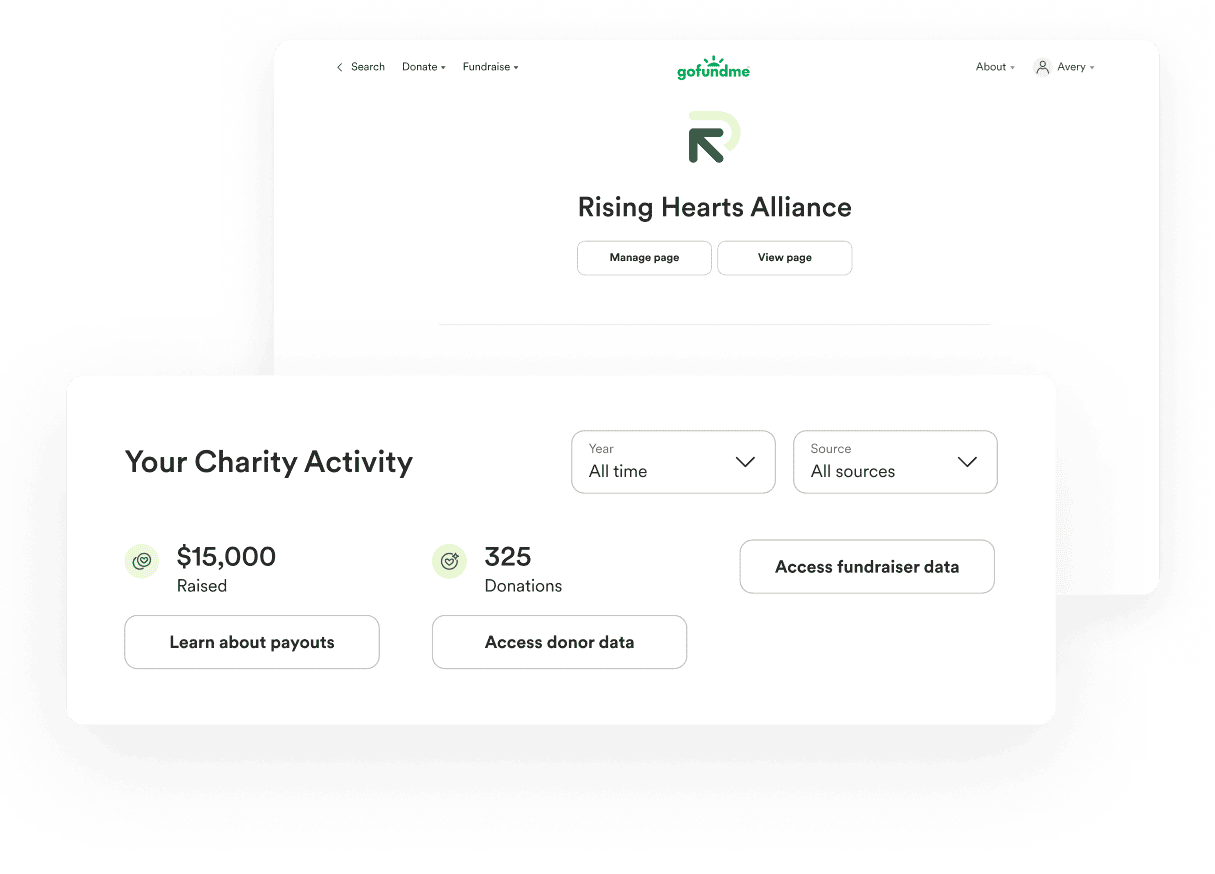
Another effective strategy is claiming your Nonprofit Page on GoFundMe. These pages enable supporters to easily find, donate, and fundraise for nonprofits on the GoFundMe platform. Your team can easily onboard and manage your organization on the site and access relevant donor data to improve your discoverability, find new potential supporters, and benefit from more supporter-led fundraising efforts.
It’s also worth checking out GoFundMe’s new streaming widgets, which integrate seamlessly with platforms like Twitch, TikTok, and Instagram, allowing you to collect donations in real time from your viewers. Fans can actively support your causes while enjoying your live content, or that of impact creators or other supporters.
8. Use events to build donor relationships
Fundraising events are an excellent way to build relationships with first-time donors. They provide a memorable introduction to your cause.
A great way to acquire new donors through events is to let current supporters bring a plus-one. You can even offer discounted ticket bundles to encourage members of your community to bring their friends.
Other ways to get the most out of donor acquisition efforts at events are to:
- Foster in-person networking between attendees and staff members.
- Host fun activities in trendy or attractive venues to draw in new supporters.
- Gift free branded swag or perks to attendees.
- Send thank-you notes, make phone calls, and offer other stewardship after the event, like a post-event survey, to show how much you value new attendees’ input.
- Make sure new supporters know their next opportunity to give or get involved.
For hybrid events, ensure your virtual component thoughtfully complements your in-person efforts. GoFundMe Pro’s Live Events can enhance attendee involvement, boost fundraising efforts, streamline event communications, and increase revenue for your cause—whether in person, virtual, or a hybrid of both.
Rocky Mountain Public Media used Live Events to improve event processes for its annual Live at the Vineyards event, raising 30% more than the previous year from over 1,400 attendees. Peloton4Parkinson’s also used the platform to host its yearly day-long spin ride, which engages virtual and in-person attendees, surpassing its fundraising goal by 14.4%.
Find the donor outreach template and script you need
Donor outreach templates and scripts make it easier to get your fundraising campaign rolling. Use these donor outreach templates and scripts to connect with supporters throughout your fundraising campaign, from the first ask to follow-up and thank-you letters. Customize each one with your nonprofit’s voice, mission, and impact to make it your own.
Initial donation letter template
When to use: When reaching out to a prospective donor for the first time
Tone: Warm, specific, and nonpressuring
Subject: An invitation to learn more about [Nonprofit]
Hi [Prospective Donor Name],
I’m [Your Name], [Title] at [Nonprofit]. We’re a [description: e.g., community food bank/environmental nonprofit/youth mentoring organization], and we’re working every day toward [brief mission statement].
I’m reaching out because [connection to donor: e.g., you recently attended one of our events/a mutual contact mentioned your passion for this cause/your foundation has supported similar work].
Last year, our work helped [specific impact: e.g., 2,400 families access fresh food/180 acres of wetland restored/300 young people complete our mentorship program]. This year, we’re working to [specific goal or next step].
I’d love to learn more about your interests and share what we’re working toward. Would you have 20 minutes for a brief call in the coming weeks?
With gratitude,
[Your Name]
Follow-up outreach letter template
When to use: 7–10 days after an initial outreach with no response
Tone: Brief, respectful, and adds new information
Subject: A quick update from [Nonprofit]
Hi [Prospective Donor Name],
I wanted to follow up on my note from last week and share a quick update from [Nonprofit].
We recently [recent accomplishment or update: e.g., completed our summer program, serving 50 more youth than last year/received a matching gift offer that doubles every donation made before [date]]. It’s an exciting step toward [brief connection to mission or impact].
If you’re interested in learning more about this work, I’d be happy to find a time to connect. And if now isn’t the right time, I completely understand.
Thank you,
[Your Name]
Year-end donor acquisition letter template
When to use: In November–December to reach prospective donors during peak giving season
Tone: Urgent and impact-focused
Subject: [Stat or impact hook: e.g., 300 families are counting on us this winter]
Hi [Prospective Donor Name],
The end of the year is our most critical time. Between now and December 31, we’re working to [goal: e.g., raise $50,000 to fund our winter meal program/secure 100 new monthly supporters].
Your tax-deductible gift can help [specific impact: e.g., put fresh, nutritious food on a family’s table/connect more young people with a dedicated mentor]. [If a match exists: And right now, a generous donor will match every gift up to $[amount]—so your gift goes twice as far.]
Will you help us reach our year-end goal? Make your gift by December 31 at [donation link].
Thank you for considering being part of what we can accomplish together.
With deep gratitude,
[Your Name]
Phone follow-up script
When to use: When following up by phone after a first in-person meeting or event
Tone: Keep the call brief and let the donor guide how long it continues
“Hi [Prospective Donor Name], this is [Your Name] from [Nonprofit]. Do you have a quick minute?”
“I wanted to personally thank you for [attending our event/connecting with us] last week. It was wonderful to meet you.”
“I also wanted to share a quick update about [specific program or impact moment]. We recently [latest update], which means [brief impact]. I remembered your interest in [relevant connection, if possible] and thought you’d appreciate hearing about it.”
“I’d love to find a time to tell you more about our work and how people like you are making it possible. Would you be open to finding a time to connect in the next few weeks?”
If yes: Schedule a time and confirm the best way to follow up.
If no: “Of course, I understand completely. Would it be alright if I stay in touch by email?”
Event introduction script
When to use: When introducing your nonprofit to a prospective donor at a fundraising event or networking gathering
Tone: Keep it brief and conversational, leading with your impact rather than your organization’s history
“Hi, I’m [Your Name] from [Nonprofit]. We [one-sentence mission with impact: e.g., connect first-generation college students in our community with mentors who help them prepare for what comes next].”
“Right now, we’re working to [current goal: e.g., expand our program to a second school/close a $20,000 funding gap before year-end].”
“Are you familiar with the issue we work on?” [Pause and continue the conversation based on their response.]
If they express interest in your work: “I’d love to stay in touch and share more. Would it be alright if I sent you a quick note this week?”
Try new strategies to find donors for nonprofit organizations
Knowing how to find donors for your nonprofit is a critical first step to building an effective fundraising strategy. With these multichannel approaches that meet donors where they are, you can be confident that your nonprofit maximizes key and untapped acquisition opportunities.
Once you feel confident about securing donations for your nonprofit, explore donor retention strategies to maximize your acquisition investments and build an ever-stronger community of support for your cause.
See how GoFundMe Pro accelerates donor acquisitionNonprofit donor acquisition FAQs
What is donor acquisition for nonprofits?
Donor acquisition is the process of identifying, reaching, and converting new individuals into donors for a nonprofit organization. It encompasses a wide range of strategies—from prospect research and peer-to-peer fundraising to social media outreach, events, and corporate partnerships—all aimed at expanding the organization’s base of financial supporters. Effective donor acquisition balances reaching the largest possible audience with targeting the prospects most likely to give and stay engaged over time.
How much does it cost to acquire a new donor?
Acquiring a new donor can cost nonprofits up to $1.50 for every $1.00 raised from that supporter, according to research from Arizona State University’s Lodestar Center for Philanthropy and Nonprofit Innovation. In contrast, retaining an existing donor costs as little as $0.20 per dollar raised. This cost disparity is why strong donor retention programs are essential complements to acquisition efforts.
The real return on acquisition investment comes from converting first-time donors into long-term recurring supporters rather than treating acquisition as a one-time transaction.
What is the most effective donor acquisition channel?
No single channel is universally most effective. The best channel depends on the organization’s existing audience, capacity, and fundraising goals:
- Peer-to-peer fundraising consistently delivers high-quality new donors because it leverages personal trust rather than organizational marketing
- Social media is most effective for awareness and younger donors
- Direct mail and emails work well for warmer prospects and year-end acquisition
The strongest donor acquisition programs combine multiple channels strategically, using warm channels first and layering additional touchpoints to increase the probability of conversion.
How do you write a donation letter to find new donors?
An effective donor acquisition letter leads with a specific impact story rather than organizational background. State who you are and what you do in one sentence, then immediately show the reader what their potential gift would accomplish with a concrete example.
- Keep the letter brief (250–400 words for emails and up to 600 words for direct mail).
- Use short paragraphs and clear language, and end with a single, specific ask.
- Earn the reader’s attention in the subject line and first sentence.
- Avoid generic openers like “I am writing to ask for your support,” which are immediately recognizable as solicitations and reduce open rates.
Find and activate passionate supporters with Nonprofit Pages
Subscribe to the GoFundMe Pro blog
Get the latest fundraising tips, trends, and ideas in your inbox.
Thank you for subscribing
You signed up for emails from GoFundMe Pro



Request a demo
Learn how top nonprofits use GoFundMe Pro to power their fundraising.