

Donation tax receipts: IRS requirements explained


Donation tax receipts do two things: help supporters keep clear records of their gifts and help nonprofits maintain accurate financial documentation.
Clear, consistent receipts confirm correctly processed donations and give supporters the information they may need for year-end tax records. They also support organized bookkeeping, greater financial transparency, and tax-exempt compliance.
This guide explains what your nonprofit needs to know to create donation receipt letters for tax purposes, so your team can spend less time on administrative tasks and more time strengthening donor relationships.
Disclaimer: This article is for informational purposes only and isn’t a substitute for tax, legal, or financial advice. Please consult a tax professional.
What is a donation tax receipt?
A donation receipt is a written acknowledgment of a donor’s contribution to a charitable organization. It helps supporters and nonprofits keep clear records of donations and gives nonprofits another opportunity to express appreciation.
5 types of donation receipts
While every donation receipt serves the same purpose, there are different formats to use based on the donation type, such as cash donations versus donated items. These are the five main donation tax receipt categories:
- Monetary donation receipts: This receipt acknowledges cash contributions donated via credit card, PayPal, or another preferred payment method.
- In-kind donation receipts: This receipt documents the value of the goods or services (noncash donations) that a supporter gifts to your nonprofit.
- Quid pro quo donation receipts: This receipt reflects goods or services your nonprofit provides in exchange for a donation. For example, supporters may receive meals and drinks in exchange for nonprofit event registration fees, or an attendee may receive a silent auction item in exchange for donating the highest bid.
- Stock donation receipts: This receipt details when a supporter donates stock shares of a company to your nonprofit, including the corporation’s name and the number of shares.
- End-of-year donation receipts: This receipt (also called a year-end giving statement) totals every gift a supporter donated to your nonprofit throughout the year. It helps taxpayers determine potential tax deductions on their annual filings.
When is a nonprofit donation tax receipt required?
The Internal Revenue Service (IRS) has specific legal requirements for when to send donation tax receipts. Always check the IRS website for the latest nonprofit requirements. In general, these scenarios include:
- When a donor’s charitable contributions are $250 or more
- When a donor receives goods or services for charitable contributions greater than $75
- When a donor specifically requests a receipt for their charitable contribution amount
Additional receipt rules may apply depending on the donation amount, gift type, and whether the donor receives anything in return:
- Timing: Donors who give $250 or more need their receipt before they file their taxes or by their filing deadline, whichever comes first. Receipts sent after a donor files their taxes won’t qualify for a charitable deduction.
- Quid pro quo valuation: If a donor gives more than $75 and receives something in return, such as a dinner, gift, or event access, your nonprofit needs to provide a good-faith estimate of the value of that item or experience.
- Noncash donations: For in-kind gifts, your nonprofit should acknowledge the noncash donation, not assign a dollar value. The donor is responsible for determining the gift’s value. If the gift is worth more than $500, the donor may need to provide you with an IRS Form 8283 to sign before being able to claim it.
- Donor-covered fees: If a donor chooses to cover your nonprofit’s payment processing or transaction fees in order for your organization to receive their full intended charitable contribution, the entire amount (the base donation plus the nonprofit’s fees covered) is generally available for a tax-deduction since all of it is intended to benefit your nonprofit. See the “How to handle donor-covered fees” section below for greater detail.
This IRS written acknowledgment requirements page details everything you need to know to substantiate a charitable contribution of $250 or more.
These requirements apply to all donations, regardless of whether a supporter provided their gift in cash, stocks, or in-kind support. Failing to provide the written acknowledgment of $250 or more doesn’t trigger an IRS penalty against your nonprofit directly, but it can prevent the donor from claiming a tax deduction.
Additionally, the $10-per-contribution penalty (capped at $5,000 per fundraising event or mailing) applies specifically when a nonprofit fails to furnish the required written disclosure statement for quid pro quo contributions over $75.
While many situations require a charitable donation receipt, it’s best practice to send one for all donor contributions. Following this process keeps your nonprofit organized and ensures ongoing compliance. You can also send and store receipts electronically to eliminate the need to print them.
How do I write a nonprofit donation tax receipt?
Donation receipts can be mailed thank-you letters or emailed acknowledgments. Select the process that works best for your nonprofit and your donors.
For example, your nonprofit might email receipts for individual gifts throughout the year, then mail each supporter a year-end thank-you message with a receipt that summarizes their total contributions.
When writing donation tax receipts, use each message as an opportunity to reinforce your nonprofit’s mission and show donors the value of their support. Keep these four steps in mind:
- Keep the formatting simple: Remember, the goal of donation tax receipts is straightforward, so keep your formatting simple too. Have a professional design, but prioritize the content.
- Include your branding: Add your nonprofit’s logo and other brand elements to make your donation tax receipts easy to recognize, reinforce your mission, and help maintain donor trust.
- Thank donors for their contribution: Take this opportunity to show donors how much they mean to your organization and express your appreciation. Include a brief paragraph explaining how the supporter’s donation will impact your work.
- Automate the process: Rely on a strong nonprofit fundraising software to send electronic receipts instantly after a donation is made, saving you time and printing costs.
Donation receipt templates for nonprofits
GoFundMe Pro automates donation receipts for every gift type, instantly sending customizable acknowledgments after each contribution. That means there’s no manual effort required.
If your nonprofit manages receipts manually, the two templates below offer a simple starting point. Copy your preferred template into a document, customize the bracketed fields for each donation, and ensure the final receipt includes all required IRS elements outlined below.
Template A: Monetary donation receipt
[Your Organization]
[Your Organization Address]|[EIN]|[Your Organization Website]
Hi [Donor First Name],
Thank you for your generous gift of $[dollar amount] to [Your Organization], received on [date of donation]. Your contribution was made by [payment method: check/credit card/online transfer] and no goods or services were provided in exchange for this donation.
[Your Organization] is a tax-exempt organization under Section 501(c)(3) of the Internal Revenue Code. Our EIN is [EIN]. This letter serves as your official written acknowledgment for tax purposes.
[Include a thank-you sentence about mission impact here.]
Sincerely,
[Executive Director Name]
[Title], [Your Organization]
Template B: Quid pro quo receipt
[Your Organization]
[Your Organization Address]|[EIN]|[Your Organization Website]
Hi [Donor First Name],
Thank you for your contribution of $[dollar amount] to [Your Organization] on [date]. In connection with this donation, you received [description of goods or services] with an estimated fair market value of $[value of goods/services]. The potentially tax-deductible portion of your contribution is $[total dollar amount minus fair market value].
[Your Organization] is a 501(c)(3) tax-exempt organization. EIN:[EIN]. Please retain this letter for your tax records.
Sincerely,
[Executive Director Name]
[Title], [Your Organization]
*These templates are for illustrative purposes only and aren’t substitutes for tax, legal, or financial advice. Please consult a tax professional.
How to create tax-compliant donation receipts
While nonprofits can style their donation receipts differently, there are legal requirements for specific elements to include. You should always have the following information on your donation receipt.
501(c)(3) donation receipt requirements
Because your organization holds 501(c)(3) status under the Internal Revenue Code, every receipt you send needs to meet the standards laid out in IRS Publication 1771:
- Name of the organization
- Donor’s name (a practical necessity for identifying the recipient, though not one of the specific content items Publication 1771 requires)
- Date of the donation
- Amount of cash contribution or a description (not the fair market value) of noncash/in-kind gifts
- Organization’s 501(c)(3) status
- Acknowledgment that donors didn’t receive any goods or services for the donation (when applicable)
- Estimate of goods and services exchanged (when applicable)
Note: Religious organizations don’t have to describe or assign value to intangible religious benefits.
Those are the basics, but you can take your receipts to the next level by adding a few other elements. Here are some ideas to get started:
- Organization’s EIN or ID number
- Contact information (such as website, phone number, and address)
- Short message of appreciation
- Executive director’s signature
How to handle donor-covered fees
When a donor elects to cover fees charged to the nonprofit, the donation record or acknowledgment should clearly identify that amount as an additional contribution for the nonprofit’s benefit, not as a separate service purchased by the donor. For example:
Total donation to nonprofit = $[dollar amount of donation, excluding fees] + $[nonprofit’s fee amount covered by donor]
Protect your nonprofit eligibility and strengthen donor relationships
Donation receipts are an important part of your nonprofit’s operations. They help strengthen donor trust, support accurate recordkeeping, and give supporters the information they need after making a gift.
Whether a donation comes through a peer-to-peer fundraising campaign or a year-end appeal, sending a clear donation tax receipt helps your nonprofit maintain transparency and make the process easier for donors.
GoFundMe Pro helps simplify this process. When supporters give through a GoFundMe Pro donation form, they automatically receive an email with their donation information and a thank-you message. You can also customize the appearance and messaging of your donation tax receipts with GoFundMe Pro’s content blocks and email features, so your team can spend less time on administrative tasks and more time on the work donors want to support.
Donation tax receipt FAQs
The IRS should always be your number one source of information for the latest requirements on donation tax receipts, but here are a few answers to frequently asked questions.
Does the IRS check donation receipts?
The IRS may review donation receipts and related records, even if it doesn’t check every receipt. Your nonprofit should keep complete, accurate records so you’re prepared if the IRS requests documentation.
Incomplete records can create compliance risks for your nonprofit and unnecessary frustration for donors. With a clear receipt process, however, your team stays organized and gives supporters the documentation they may need.
Can you use a donation receipt template?
Yes. Start with a donation receipt template that includes the required legal information. Then, customize it based on the type of gift, such as a monetary donation or noncash contribution.
Review your templates at least once a year to make sure they reflect current requirements and your nonprofit’s receipt process.
What is required on a 501(c)(3) donation receipt?
A 501(c)(3) donation receipt must include:
- Organization’s legal name
- Date of the donation
- Amount donated or a description for noncash gifts
- 501(c)(3) tax-exempt status
- Statement indicating whether any goods or services were exchanged
Including the EIN is optional but strongly recommended.
When must a nonprofit send a donation receipt?
For donations of $250 or more, the IRS requires a written acknowledgment before the donor files their tax return. For donations under $250, no written acknowledgment is legally required, though sending one is best practice for donor relations. For quid pro quo donations exceeding $75, written disclosure is required regardless of the donation amount.
Can I use the same receipt template for all donation types?
No. A standard monetary donation receipt states no goods or services were exchanged. A quid pro quo receipt must include the fair market value of what the donor received and the tax-deductible portion. An in-kind receipt acknowledges the donated item without assigning a value. These differences matter, and the template you use should accurately reflect the donation type.
Do you need to send recurring donors monthly donation receipts?
Not always. In many cases, an end-of-year donation receipt that includes the donor’s total contributions for the year may be enough. Still, monthly receipts can be a helpful option for donors who prefer more frequent records.
Ask recurring donors whether they’d like monthly receipts in addition to their year-end statement. If you don’t send monthly receipts, consider sending an initial thank-you receipt when a donor starts their recurring gift and another acknowledgment on each anniversary.
You can also let donors know what to expect going forward, including when they’ll receive tax documentation and how often they’ll hear updates about your nonprofit’s work.
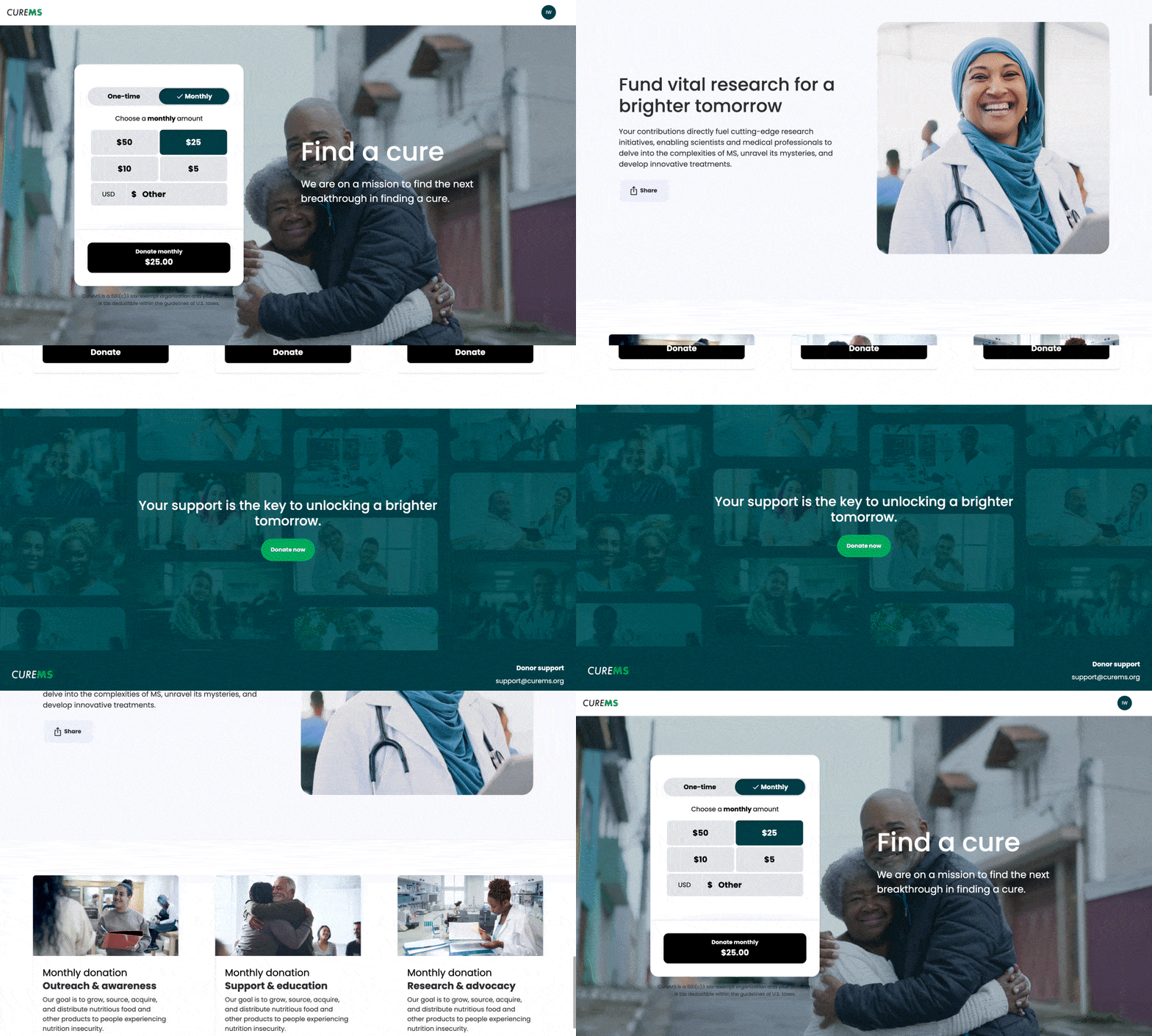
See GoFundMe Pro in action
Subscribe to the GoFundMe Pro blog
Get the latest fundraising tips, trends, and ideas in your inbox.
Thank you for subscribing
You signed up for emails from GoFundMe Pro



Request a demo
Learn how top nonprofits use GoFundMe Pro to power their fundraising.