

AI search strategy for nonprofits: Adapting to the changing ways people find information


This blog was written by Spencer Brooks and Ania Cotton. Spencer is the founder of Brooks Digital, where he helps health nonprofits stay relevant as patients increasingly turn to AI for health guidance. Ania Cotton is an SEO and Data Analytics Manager who develops marketing strategies that combine creative storytelling with data-driven insights.
Nonprofits face a moment of uncertainty and opportunity, as artificial intelligence (AI) reshapes how people seek and trust information. Many question what this shift means for their visibility, their missions, and their connection to the communities they serve, but the greater risk may be inaction.
In 2024, one of Brooks Digital’s nonprofit clients reported losing 36% of its web traffic. For an organization that had built its audience to 5 million annual site visitors, that meant 1.8 million people stopped showing up. What initially appeared to be an algorithm update or temporary dip revealed something much bigger: A structural shift in how people find information online.
If your organization relies on the web to educate, build awareness, attract supporters, or demonstrate impact, this framework will help you understand what’s changing, assess how much it affects you, and decide what to do about it.
AI search is a generational platform shift
The best description for what we’re living through right now is a generational platform shift, similar in certain ways to the introduction of the smartphone.
In 2006, the motorola razr was the most popular phone on the market, and the iPhone didn’t exist. When Steve Jobs unveiled it in 2007, it was a lightning-rod moment. Tech historians recall the audience audibly gasping as he scrolled through music and used pinch-to-zoom on a photo.
Skeptics were loud, too. They argued that it lacked a physical keyboard, that people didn’t want an all-in-one device, and that it was just “an expensive toy.”
Much of the phone market stayed in denial for about two years. However, by 2009, business professionals and tech enthusiasts were adopting smartphones in earnest. By 2011, you were behind if you didn’t have one. And BlackBerry, once the king of business phones, was already in decline.
The shift from “the iPhone is a niche tech product” to “a smartphone is a mainstream necessity” took about 48 months.
Now, let’s map that same pattern onto AI. ChatGPT launched in November 2022. Two months later, it hit an estimated 100 million monthly active users. As of early 2026, more than 900 million people use it weekly. We’re currently 40 months out from launch, which is squarely in the middle of the mainstream adoption phase.
However, the adoption numbers alone aren’t the point. What matters most about platform shifts is that they change people’s behavior. And behavior shifts don’t reverse.
How search behavior is changing
Search used to work like this: A person has a question, types it into Google, gets a page of blue links, clicks one, and visits your site. That was the model most nonprofits built their digital strategies around. And for a long time, it worked pretty well.
Now, increasingly, it works like this: A person has a question, types it into ChatGPT or gets a Google AI Overview (AIO) answer, and ends their search. They never click anything, they never visit your site, and they may never know your organization exists.
The data backs this up. Since Google rolled out AIO to all U.S. users in mid-2024, 80% of searches with AIO result in zero clicks (versus 60% without AIO). About 50% of searches are answered directly by AIO. And studies show that 37% of people are now starting their search with AI tools instead of Google altogether.
What this looks like in practice
diaTribe is a nonprofit on a mission to help people make sense of diabetes. The team takes complex medical and scientific information and translates it so anyone can understand and act on it.
Before AI, people with diabetes would Google their questions, discover diaTribe’s articles, and become ongoing readers. Over time, this strategy helped the organization grow to nearly 6 million annual site visitors and 580,000 email subscribers. That reach was a major part of its fundraising narrative.
Now, people can ask AI many of those same questions and get specific, personalized answers. Sometimes the answers are even synthesized directly from diaTribe’s content. The person gets what they need, but they never visit diaTribe’s site, may never discover the organization exists, never subscribe, and never become a supporter.
So in the age of AI, how do people discover you exist? How do you build an audience? How do you demonstrate value to funders? How do you accomplish your mission?
For some nonprofit organizations, responding to AI search isn’t just about maintaining visibility. It’s about acknowledging the fact that these trends fundamentally disrupt your value proposition and seizing that opportunity.
A framework for assessing your risk
Before you decide how to respond, you must understand where your organization sits.
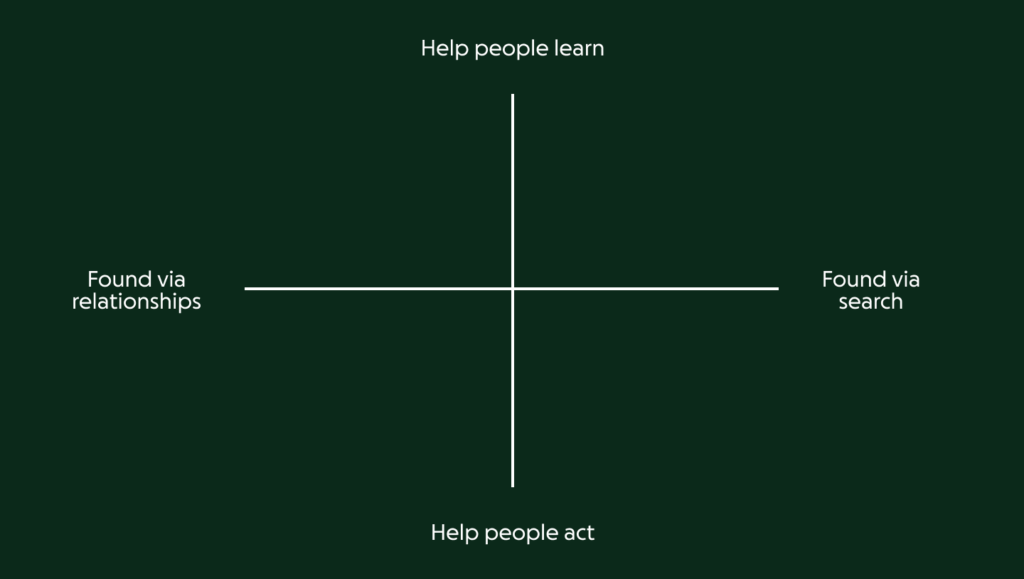
The framework has two axes. The horizontal axis is discovery. On the left, people find you through relationships, referrals, or events, and your website mainly serves people already in your network. On the right, people find you through search because you have the answer they need.
The vertical axis is value. At the bottom, value is action-driven, such as relationships, credentialing, advocacy, or mobilization. AI cannot replace that. At the top, value is information-driven, such as explaining, analyzing, or educating, which is exactly what AI is learning to do.
These axes create four quadrants.
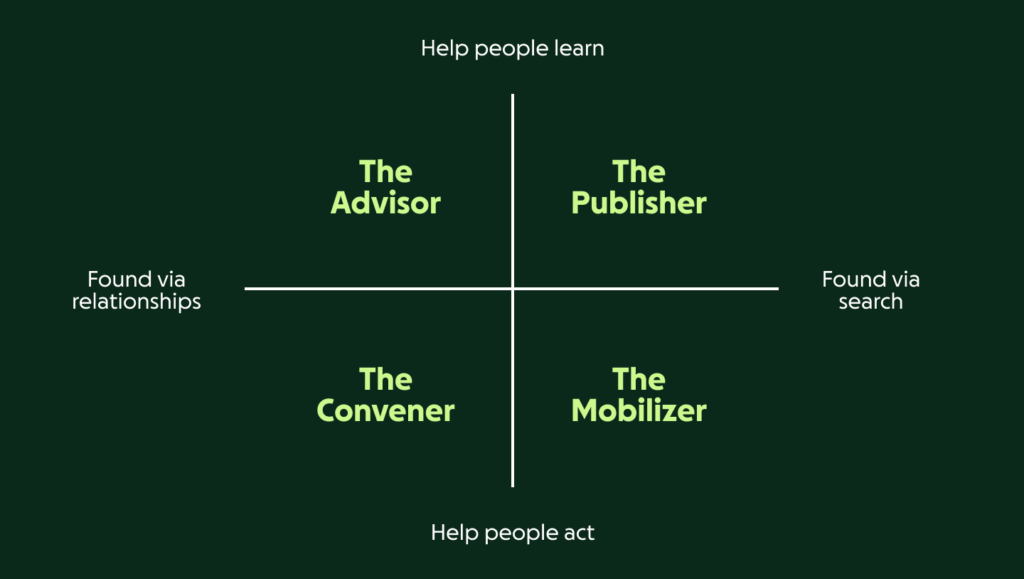
- The Conveners include local associations, executive peer groups, and in-person service organizations. People come for each other, and AI search is not a major concern.
- The Mobilizers include certification bodies, advocacy groups, and disaster response nonprofits. They rely on search to reach new people, but AI cannot replace their core values, such as certification, community, or action. Their challenge is discovery.
- The Advisors include trade associations and professional guidance organizations. Their value lies in interpreting what’s happening in an industry. AI is becoming good at this kind of synthesis, which makes this quadrant more exposed over time.
- The Publishers include organizations like diaTribe. They rely on search, and their core function is explaining complex information. AI competes directly with that work while also intercepting discovery.
Organizations in the same quadrant can still require different responses depending on how prepared they are for AI search. That’s where GEO comes in.
How to respond using GEO
The reality is that nonprofit organizations are adapting to the AI-driven search landscape at very different speeds. Some are still relying entirely on traditional search strategies. Others are rethinking how to structure, measure, and distribute their content.
There’s a simple framework that organizations can use to evaluate their readiness: the GEO (Generative Engine Optimization) Maturity Framework. Nonprofits can assess where they sit and what steps their teams can take to improve their digital visibility in the AI search era.
The framework divides readiness into four stages: Standing, Walking, Running, and Soaring.
Understanding the GEO Maturity Framework
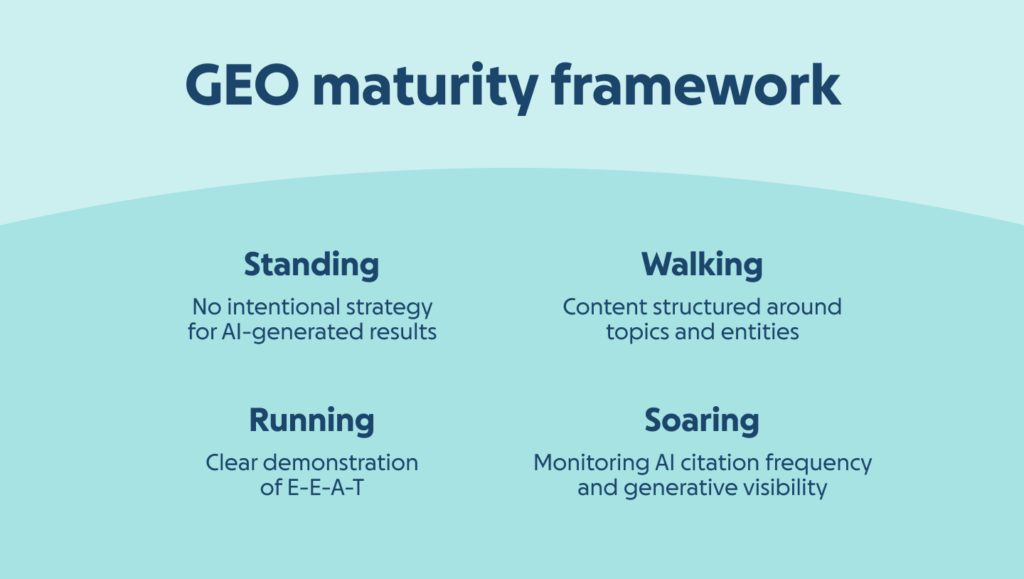
The goal isn’t to jump straight to the most advanced stage. Instead, it’s about understanding where you are today and identifying the next step forward.
Standing: AI visibility is accidental
At the standing stage, organizations still operate primarily under the traditional SEO model. Content is optimized for keywords and rankings, but there’s little intentional strategy around how AI tools interpret or surface that information. Visibility in AI-generated responses is largely accidental.
This stage often includes organizations that:
- Rely solely on traditional SEO tactics without adopting new AI strategies
- Don’t monitor search trends via Google Analytics 4 or Google Search Console
- Haven’t adjusted their content structure for AI interpretation
- Focus heavily on traffic metrics, like pageviews and rankings
The risk is that traditional search may still look healthy while visibility declines in emerging AI search experiences. Search engines and AI platforms increasingly prioritize direct answers, summaries, and conversational results. And if content isn’t structured in ways these systems can easily interpret, it may never appear.
The good news is that moving beyond this stage rarely requires a full overhaul. Small improvements to how content is structured and organized are often enough to start.
Walking: AI starts understanding your content
In the walking stage, organizations begin structuring their content in ways that make it easier for AI systems to interpret. Instead of focusing solely on keywords, content starts to revolve around topics and entities, the key concepts and ideas that define your organization’s expertise.
Organizations in this stage often:
- Organize content around core topics instead of isolated keywords
- Use clear headers and semantic structure throughout articles
- Build strong internal linking between related resources
- Implement basic schema markup to clarify content context
At this stage, AI systems can start to understand what your organization does.
Instead of simply ranking for individual search queries, your organization begins to develop topical authority around the issues you care about most.
Many nonprofits are already partway into this stage after years of building mission-focused content libraries. The key now is ensuring the content is structured in a way that humans and AI systems can easily interpret.
Running: AI trusts and references your content
The running stage focuses on authority and credibility. As AI tools become more sophisticated, they’re increasingly capable of identifying which sources demonstrate genuine expertise. Content that reflects strong E-E-A-T (experience, expertise, authority, and trustworthiness) principles is more likely to be referenced in AI-generated responses.
Organizations in the running stage often prioritize:
- Articles written or reviewed by subject matter experts
- Visible author credentials and bios
- Original research, surveys, or proprietary insights
- Strong backlinks and citations from reputable sources
At this point, your content is no longer just understood. It’s trusted. This is critical to help you reach new audiences, demonstrate E-E-A-T to your audiences, and become a source that users and AI reference.
This is where many nonprofits have a natural advantage. Mission-driven organizations frequently produce unique research, host expert voices, and gather valuable insights from their communities. Those assets can become powerful authority signals in the AI search ecosystem.
Soaring: Influencing the narrative
The most advanced stage of the framework, soaring, involves proactively shaping how information about your industry appears in AI-generated responses. Organizations in this stage aren’t simply reacting to changes in search. They’re actively monitoring and adjusting their strategy based on how AI systems interpret and surface information.
This may include:
- Monitoring AI mentions and generative search visibility
- Tracking how AI tools describe your organization or mission
- Adjusting content structure based on AI behavior
- Proactively creating content around emerging questions or issues
At this level, organizations help shape how AI explains their mission and its impact to the public.
Your organization’s next step will depend on its maturity. Once you’ve identified where you are, choose one focused action from the Optimize, Measure, Monitor framework below to keep moving forward.
Optimize existing content for AI-powered search
If you haven’t already, the first step is making your content easier for AI systems to understand and reference.
Many of the strategies that improve traditional SEO also enhance generative search visibility, but they need to be applied more intentionally.
Some practical starting points include:
- Adding FAQ sections to high-value pages
- Structuring content with clear headers and subheaders
- Defining important terms directly within your content
- Building dedicated pages for priority topics
- Highlighting the expertise of authors or contributors
- Publishing original insights, research, or data
- Improving internal linking between related topics
- Including first-hand member case studies
- Repurposing webinars into structured Q&A, articles, and glossary entries
These adjustments help AI tools recognize your organization as a reliable source of information.
They also improve the experience for human readers, making your content easier to scan, understand, and share.
Measure success through analytics and reporting
One of the biggest shifts nonprofits may notice in the AI search era is a change in traditional traffic patterns.
As AI tools increasingly deliver answers directly within search results, fewer users may click through to websites. This trend often called “zero-click search” can cause pageviews to decline even while visibility increases. Views and clicks may be impacted, but impressions can improve due to your content being shown and cited in different AI responses. You need to be strategic with how you reach your audience, which means organizations need to rethink what success looks like.
Instead of focusing exclusively on traffic numbers, consider tracking metrics that reflect the relationship depth and engagement, such as:
- Direct traffic trends
- Google Search Console queries and engagement
- Branded search growth
- Email sign-ups
- Engagement time
These indicators often reveal more about long-term impact than raw traffic numbers alone.
Search visibility may introduce people to your organization, but deeper engagement happens through the relationships you build afterward.
Monitor AI-driven search trends and adjust strategy
AI-powered search is not static: New features, platforms, and user behaviors continue to emerge. Nonprofit organizations that succeed in this environment evaluate trends regularly and adapt their workflows to stay aligned with how people actually search for information.
You can analyze how audiences engage and learn new ways to adjust your strategy by:
- Using tools like Google Analytics and Google Search Console to identify shifts in search queries, impressions, and user behavior
- Monitoring competitor content structure and topic coverage
- Looking for search patterns among queries
- Diversifying content distribution channels strategically
Invest in channels you own
As search platforms evolve, the most resilient organizations will be those that strengthen the channels they control directly.
Search will continue to play a crucial role in discovery and awareness, but long-term sustainability depends on building relationships beyond search engines.
That means investing in channels such as:
- Blog content
- Email newsletters
- SMS communications
- Recurring donor programs
- Peer-to-peer fundraising campaigns
- Community engagement initiatives
These channels allow organizations to stay connected with supporters regardless of how search algorithms or AI platforms change in the future.
The time is now to adapt to changing AI search
The question isn’t whether AI will change search. It’s already happening. The question is whether you’ll adapt while you have runway to experiment and learn.
Organizations that move now, even if they’re not perfect, will be in a stronger position than those who wait and see. You don’t need to overhaul everything, but you do need to understand where you sit, what level of response that calls for, and how to take the most important next step.
Remember, platform shifts reward the organizations that take them seriously early on. Your nonprofit doesn’t have to get it perfect. You just have to start.
Copy editor: Ayanna Julien
Subscribe to the GoFundMe Pro blog
Get the latest fundraising tips, trends, and ideas in your inbox.
Thank you for subscribing
You signed up for emails from GoFundMe Pro


Request a demo
Learn how top nonprofits use GoFundMe Pro to power their fundraising.